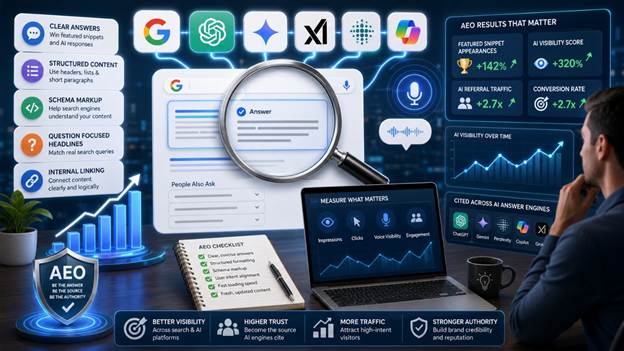
To stand out online today, simply focusing on keywords and links isn’t enough. Answer Engine Optimization (AEO) is how websites now earn better visibility by providing clear, direct answers. With over 65% of searches now ending without a single click and AI Overviews appearing in nearly 55% of Google results, brands that aren’t structured for AI extraction quietly lose visibility every day. We help you understand and adopt AEO to improve your search visibility across Google, ChatGPT, Gemini, Grok, Perplexity and other AI-powered answer engines.
What Exactly Is Answer Engine Optimization (AEO)?
Answer Engine Optimization (AEO) means shaping your content to provide clear answers to questions people search for. Unlike regular SEO that targets rankings based on keywords, AEO targets featured snippets, voice responses, and direct answers from search engines and AI assistants. Google now frequently shows these direct answers above regular search results, making AEO crucial for better online visibility. AEO is also the technical foundation of Generative Engine Optimization (GEO), the broader practice of earning brand mentions inside ChatGPT, Gemini, Grok, Claude and Microsoft Copilot answers, where citations now drive a measurable share of high-intent traffic.
Why Is Answer Engine Optimization (AEO) Essential for Modern SEO Strategies?
Most users today prefer instant answers rather than clicking through multiple links. AEO meets this need by placing your answers directly into Google featured snippets, “People Also Ask” boxes, and voice search results. With ChatGPT alone serving over 700 million weekly users and processing billions of prompts daily, the discovery layer has shifted from a list of links to a single synthesized answer. If your website isn’t optimized for these features, you are losing valuable exposure. Modern SEO strategies now need AEO to effectively reach and engage users, especially since Gartner projects traditional search volume will drop nearly 25% by the end of 2026.
How Does AEO Differ from Traditional SEO Practices?
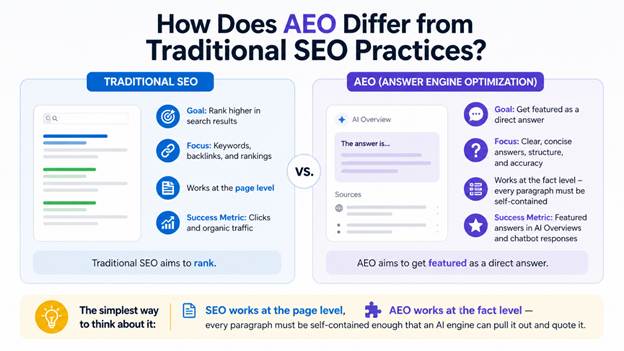
Traditional SEO involves optimizing pages to rank highly in search results through keywords and backlinks. AEO focuses specifically on creating concise, accurate answers that search engines easily feature. AEO requires content structured clearly, often using question-and-answer formats, lists, and structured data (schema markup). The simplest way to think about it: SEO works at the page level, while AEO works at the fact level every paragraph must be self-contained enough that an AI engine can pull it out and quote it. In short, traditional SEO aims to rank, while AEO aims to get featured as a direct answer inside AI Overviews and chatbot responses.
What Are the Key Components of Effective Answer Engine Optimization?
- Clear and direct answers: Keep answers brief and directly related to the user’s question.
- Structured formatting: Use headers, bullet points, numbered lists, and short paragraphs.
- Schema markup: Helps search engines quickly understand content structure.
- Question-focused headlines: Craft headlines that closely match real search queries.
- Consistent internal linking: Connect relevant content on your site clearly and logically.
By adopting these strategies, your content becomes prime material for search engines to feature directly in search results. Adding a definition-led opening sentence to every section the “Entity is a category that differentiator” pattern also dramatically improves how reliably ChatGPT, Gemini and Grok extract and cite your content as the source of truth.
How Can Implementing AEO Improve Your Website Search Performance?
When you use AEO effectively, you become more visible through featured snippets, AI Overviews and voice searches. These prominent placements drive more traffic and position your website as an authority. Recent industry data shows that AI-crawled websites generate up to 320% more human traffic and convert at roughly 2.7 times the rate of pages that aren’t AI-visible largely because AI assistants pre-qualify visitors before they ever land on your site. This visibility means users see your answers first, increasing your site trustworthiness and overall traffic. Implementing AEO significantly boosts your site relevance and engagement.
What Mistakes Should You Avoid When Implementing Answer Engine Optimization?
- Long, unclear answers: Search engines prefer precise answers.
- Neglecting structured data: Without schema markup, search engines can’t easily interpret your content.
- Overusing keywords: Answer clearly and naturally, not artificially.
- Ignoring user intent: Answers must match exactly what users are searching for.
- Slow website loading speeds: Quick-loading pages perform better in featured snippets.

By avoiding these pitfalls, your AEO strategy becomes stronger and more effective. Two more silent killers worth flagging: inconsistent brand entity information across the web (different addresses, services or descriptions) and outdated content. AI engines reward fresh, authoritative sources, so brands that publish once and forget rarely earning citations in modern AI-generated responses.
Working with a specialized AEO agency can dramatically shorten the time it takes to see these results. While traditional SEO teams focus on rankings and backlinks, a dedicated AEO agency builds a measurable framework around AI citations auditing how often your brand currently appears in ChatGPT, Gemini, and Perplexity answers, mapping prompt opportunities your competitors are winning, and engineering content that AI engines extract first. This combination of strategy, technical schema deployment and continuous monitoring is what separates brands earning consistent AI mentions from those still relying on outdated SEO checklists.
How Can You Measure the Success of Your AEO Efforts?
- Featured snippet appearances: Tools like SEMrush and Ahrefs show snippet placements.
- Clicks and impressions: See how often your answers appear and attract clicks.
- Voice search visibility: Track if your content is read aloud by voice assistants.
- Engagement metrics: Monitor bounce rates and session durations from snippet clicks.
Regular monitoring helps you refine your AEO strategy effectively. Modern AEO measurement should also include AI visibility tracking how often your brand is cited inside ChatGPT, Gemini, Perplexity, Copilot and Grok answers along with share of voice against competitors and the sentiment of those mentions. These metrics reveal what classic rank-tracking tools simply cannot.
What Are the Future Trends and Predictions for Answer Engine Optimization?
Choosing the right AEO agency is now as important as choosing the right SEO partner was a decade ago. Look for an AEO agency that tracks visibility across at least five answer engines (ChatGPT, Gemini, Grok, Perplexity and Google AI Overviews), publishes transparent citation reports, and aligns content production with prompt-level intent rather than keyword volume alone. The right partner will not only secure your spot inside AI answers today but also future proof your brand against ongoing shifts in how people search and how machines respond.
Frequently Asked Questions (FAQs)
1. How do you optimize content for ChatGPT, Gemini, and Grok citations?
To get cited by ChatGPT, Gemini and Grok, lead every section with a 40–60 word answer block using a definition-led structure. Add credible statistics, implement FAQPage and Article schema markup and maintain consistent brand entity signals across every webpage and external citation source.
2. What schema markup types are most effective for AEO success?
FAQPage, Article, Organization, HowTo and Product schema deliver the strongest AEO performance. They help answer engines correctly identify entities, page purpose and authoritative authorship, increasing your chances of being selected as the cited source within AI-generated responses across multiple platforms.
3. How does AEO connect with Generative Engine Optimization (GEO)?
AEO is the technical foundation within GEO’s broader framework. While AEO focuses on extractable, citable content, GEO covers the wider strategy including brand entity building, source ecosystem management, and AI visibility measurement across ChatGPT, Gemini, Perplexity, Copilot and Grok platforms.
4. Which AEO metrics indicate true ROI beyond traditional rankings?
Track AI visibility score, citation frequency, share of voice against competitors, sentiment drift and AI-driven referral conversions. These metrics reveal how often your brand is cited, how positively it is described and whether AI traffic delivers higher-intent buyers than organic search.
5. How frequently should AEO content be refreshed for AI engines?
Brands leading in AEO refresh priority pages quarterly at minimum, with high-traffic pillar content updated every 30–60 days. AI models prioritize fresh, dated and recently revised sources, so consistent updates with new statistics, examples and dateModified schema directly improve citation likelihood.
At High Clarity, we help you clearly navigate and implement AEO to ensure your website remains visible and competitive across every modern answer engine.